




RBT supervision requirements are the ongoing standards Registered Behavior Technicians must follow to keep their certification active while providing behavior-analytic services.
In ABA practice, RBTs do not work independently. They provide direct support under the close, ongoing supervision of a qualified BCBA or BCaBA Supervisor. Ongoing supervision helps RBTs improve and maintain behavior-analytic, professional, and ethical skills while supporting high-quality services for clients. For those starting an RBT career, supervision is one of the first continuing requirements to understand.
When supervision is done well, it is more than a monthly task. It becomes part of how ABA teams support clients, coach staff, review service quality, and build stronger clinical practice.
Why RBT Supervision Requirements Matter in ABA Services
RBT supervision supports ethical ABA care through observation, performance review, and feedback. This matters because treatment plans only help when RBTs carry them out correctly during sessions. Through supervision, BCBAs and BCaBAs can see how skills are taught, how behavior plans are followed, and how data is collected.
For RBTs, supervision also creates space to ask questions, receive coaching, and build skills over time. This support is especially helpful for newer RBTs who are still learning how to apply behavior-analytic principles in practice.
For supervisors, it helps maintain clinical oversight. A BCBA or BCaBA may not be present for every session, but supervision keeps them connected to the client’s progress and the RBT’s daily work.
Strong supervision also supports a healthier team culture. Clear feedback, organized documentation, and regular observation help RBTs feel supported while helping teams provide more consistent care.


Monthly RBT Supervision Requirements
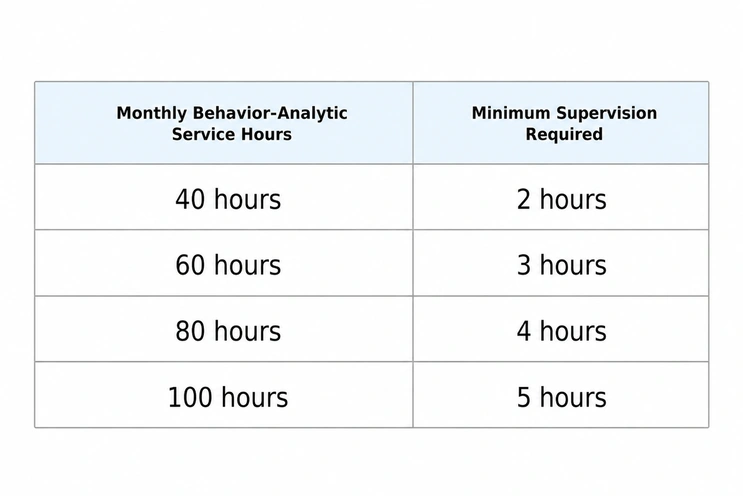
The BACB requires RBTs to receive ongoing supervision for at least 5% of the hours they spend providing behavior-analytic services each calendar month.
This requirement is based on behavior-analytic service hours, not total work hours. For example, direct ABA service time counts toward the total used to calculate supervision. Other work tasks may not count the same way, depending on the role and setting.
Because the requirement resets each calendar month, RBTs and supervisors should track service hours and supervision time throughout the month. Waiting until the end can make it harder to confirm that all requirements were met.
For example, if an RBT provides 80 hours of behavior-analytic services in one month, they need at least 4 hours of supervision.
RBTs must also meet supervision requirements at each organization where they provide behavior-analytic services. An RBT cannot simply combine partial supervision from separate workplaces unless the supervision structure meets BACB rules for that organization. Each workplace should have a clear system for tracking supervision, records, and oversight.
How to Calculate the 5% RBT Supervision Requirement
To calculate the 5% requirement, add up the RBT’s behavior-analytic service hours for the month. Then multiply that number by 0.05.
For example:
80 behavior-analytic service hours × 0.05 = 4 supervision hours
This gives the minimum amount of supervision needed for that calendar month.
A simple tracking system can help RBTs and supervisors stay current. Teams may use a shared log, supervision form, scheduling tool, or internal system to track service hours, supervision sessions, observation dates, and follow-up items.
The goal is not only to meet the minimum number. Supervision should be timely, useful, and connected to the services provided.
Required Supervision Contacts for RBTs
The BACB requires at least two face-to-face, real-time supervision contacts each month. Supervision may not happen only by phone or email. This does not always mean the RBT and supervisor must be in the same room. In-person observation is preferred, but video conferencing or similar tools may be used when appropriate and when allowed by applicable laws.
At least one monthly meeting must include the supervisor observing the RBT providing services. This gives the supervisor a direct view of how the RBT works with the client, follows the plan, collects data, and responds during the session.
Passive video monitoring alone may not count. A supervisor watching a recording or checking in by email is not the same as real-time supervision. RBT supervision should include active communication, feedback, and clinical direction.
Individual and Group Supervision Requirements
At least one of the two monthly supervision sessions must be individual. This means no other RBTs or trainees are present.
The other session may be a small-group meeting. A small-group supervision is an interactive meeting with 2–10 RBTs who share similar experiences. The group may not exceed 10 RBTs, even if more than one supervisor is present.
Both formats can be useful. Group supervision can support shared learning, while individual supervision gives the RBT direct feedback on their own performance, client needs, and skill development.
Who Can Supervise an RBT?
According to the BACB, a BCBA may serve as a supervisor or RBT Requirements Coordinator. While a BCaBA may serve as a supervisor. The BACB also requires an 8-hour supervision training for those who supervise RBTs.
Supervisor (BCBA or BCaBA)
A supervisor provides supervision and is responsible for the behavior-analytic services the RBT provides. In many ABA organizations, this role is held by a BCBA or BCaBA.
The supervisor may observe sessions, provide feedback, review notes and data, offer training, and guide ethical and professional behavior.
The BACB also states that supervisors must have enough client-specific knowledge to guide the RBT’s clinical work. This means supervision should stay connected to the services the RBT provides and the client’s treatment needs.
RBT Requirements Coordinator
Some organizations use an RBT Requirements Coordinator structure when an RBT has multiple supervisors or when supervision happens across several teams, sites, or clinical leaders.
In this model, the RBT Requirements Coordinator helps coordinate supervision across supervisors. This structure can help organizations track supervision requirements, maintain records, and support communication among supervisors.
A Coordinator may also serve as a supervisor when qualified. However, an RBT may only have one RBT Requirements Coordinator per organization.
This role helps reduce confusion when several supervisors are involved. It clarifies who oversees monthly supervision, documentation, and compliance checks.
Supervisor Training Requirements
Supervisors who provide ongoing supervision to RBTs must complete an 8-hour supervision training before supervision begins.
This requirement reinforces that RBT supervision is a professional responsibility. Supervisors need the right preparation to guide, coach, and oversee RBTs in a responsible way.

What Counts as RBT Supervision?
RBT supervision can include several activities, such as observation, behavioral skills training, performance feedback, review of written materials, and support with professional and ethical behavior.
In practice, supervision may include:
- Watching the RBT work with a client
- Reviewing data sheets or session notes
- Practicing teaching steps through role-play
- Giving feedback after an observation
- Modeling how to respond during a session
- Discussing ethical concerns
- Reviewing client progress
- Planning next steps for skill improvement
RBT supervision should stay connected to the services the RBT provides. A general training or staff meeting may not count as supervision unless it meets the specific supervision requirements. The BACB also treats ongoing supervision and professional development as separate requirements, so one event cannot cover both.
Many of these skills also appear during the RBT Competency Assessment, which is why new technicians should understand how observation, feedback, and skill practice fit into ABA training.
Direct Observation During RBT Supervision
Direct observation is a key part of RBT supervision. It allows the supervisor to see what happens during a session instead of relying only on notes or verbal updates.
During an observation, a supervisor may look at how the RBT:
- Follows the behavior plan
- Uses teaching procedures
- Responds to client behavior
- Collects data
- Communicates with the client
- Uses prompts and reinforcement
- Maintains professional boundaries
- Responds to coaching
Observation helps supervisors notice details that may affect service quality, such as timing, prompting, data accuracy, or transitions between activities. It also gives them a stronger basis for clear and useful feedback.
Feedback and Skill Development
Feedback should be clear, specific, and useful. RBTs need to know what they are doing well and what they need to adjust.
For example, a supervisor may point out that reinforcement was delivered at the right time. They may also coach the RBT to wait longer before giving a prompt so the client has more time to respond independently.
This kind of feedback makes supervision practical. For newer RBTs, it can build confidence. For experienced RBTs, it can sharpen skills and support consistency across clients.
RBT Supervision Requirements and Documentation
Supervision documentation is a key part of meeting RBT supervision requirements. The BACB states that RBTs and their supervisor must keep records that show supervision requirements are being met.
These records should include the dates and times of behavior-analytic services, the dates and duration of supervision, the supervision format, direct observation dates, supervisor names, proof of the supervisor’s relationship to the client, and any additional records needed.
The BACB also requires these records to be kept for at least 7 years, even if the supervisory relationship ends or another person takes over supervision.
Clear documentation does more than support compliance. It helps teams track supervision quality, RBT growth, and clinical follow-through. It also makes transitions easier if a supervisor changes, since the next supervisor can see what has already been reviewed and what still needs support.
Since supervision records help keep an RBT credential active, it is also important to understand how to renew RBT certification and avoid gaps in certification status.
What Happens If RBT Supervision Requirements Are Not Met?
RBTs must have a qualified supervisor on record with the BACB to practice as an active RBT. The BACB states that an RBT’s certification must be active for the person to practice, bill, or represent themselves as an RBT.
If an RBT does not have a supervisor or coordinator on record, they may not practice. Newly certified RBTs are also inactive after passing the exam until a qualified supervisor adds them as a supervisee in their BACB account.
This is why RBTs should know who supervises them and confirm that the correct person is listed. ABA organizations also need a clear process for adding or removing supervisees when roles, schedules, or staff change.
If an RBT is unsure whether supervision requirements are being met, they should review current BACB guidance and speak with their supervisor.
Why ABA Organizations Need Clear Supervision Systems
A strong supervision system helps RBTs, supervisors, and organizations stay aligned. It should make clear who supervises each RBT, who is listed in the BACB account, how service and supervision hours are tracked, when direct observation happens, where records are stored, and who reviews documentation before the month ends.
These details may seem simple, but they can become harder to manage as a team grows. A small team may only have a few RBTs and one or two supervisors. A larger team may have several locations, multiple BCBAs, BCaBAs, and many RBTs.
Conclusion
RBT supervision requirements are an important part of ethical, high-quality ABA practice. They help support clinical oversight, service consistency, and professional growth for RBTs.
Supervision gives RBTs coaching, feedback, and guidance during real client work. BCBAs and BCaBAs use it to maintain oversight of how treatment plans are carried out. Organizations also benefit from a clearer structure for documentation, staff support, and service quality.
Strong ABA teams do not treat supervision as a last-minute task. They make it part of clinical care.
At Mindful Sprouts, we value supportive supervision, collaboration, and thoughtful ABA practice. If you are an RBT, or ABA professional looking for a team where growth and quality care matter, we invite you to explore open opportunities with us.
For more guidance on ABA practice and family-centered care, follow Mindful Sprouts on LinkedIn, Instagram, Facebook, and X (Twitter).
FAQs About RBT Supervision Requirements
1. How many supervision hours does an RBT need each month?
An RBT must receive ongoing supervision for at least 5% of the hours they spend providing behavior-analytic services each calendar month. For example, if an RBT provides 80 hours of behavior-analytic services in one month, they need at least 4 hours of supervision.
2. How many RBT supervision contacts are required each month?
RBTs must receive at least two face-to-face, real-time supervision contacts each month. At least one of those contacts must include the supervisor observing the RBT providing services. In-person observation is preferred, but real-time video conferencing may be used when appropriate and legally allowed.
3. Who can supervise an RBT?
A BCBA may serve as a supervisor or RBT Requirements Coordinator. A BCaBA may serve as a supervisor. The BACB also states that the 8-hour supervision training is required for those supervising RBTs.
4. Can an RBT work without a supervisor?
No. An RBT must have a qualified supervisor or RBT Requirements Coordinator on record with the BACB to practice as an active RBT. If an RBT does not have a qualified supervisor or coordinator on record, they may not practice, bill, or represent themselves as an active RBT.




Leave A Comment